This is one of the most common reasons people decline hormone therapy, and it rests on a misunderstanding. The short answer:
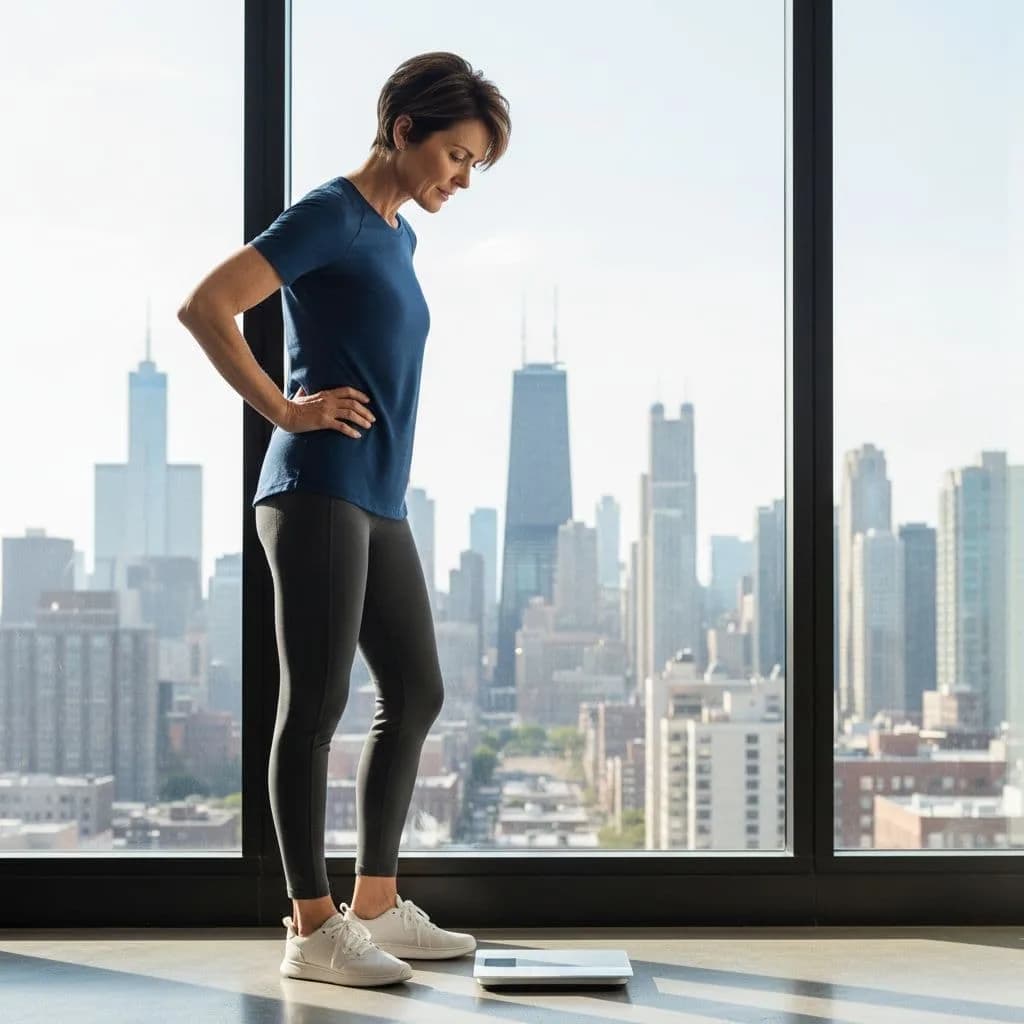
Hormone therapy does not cause meaningful weight gain. It also is not a weight-loss treatment. What it does change is where your body stores fat — and that is worth understanding, because it is a real effect that gets confused with the number on the scale.
What the evidence shows
Randomised trials and systematic reviews comparing hormone therapy with placebo have not found significant weight gain attributable to HRT. Some analyses have found slightly less gain in the HRT group.
The confusion is a timing coincidence. Menopause happens in midlife, and midlife is when most people gain weight regardless of hormones. Muscle mass declines from roughly the fourth decade onward, resting metabolic rate falls with it, and activity levels typically drop. That trajectory is present whether or not you take hormones, so anything started at the same time gets the blame.
What HRT does change: fat distribution
This is the real and well-documented effect.
Falling estrogen shifts fat storage from the hips and thighs toward the abdomen — the visceral pattern associated with insulin resistance and cardiovascular risk. Estrogen therapy partially counteracts that shift.
The practical consequence: on HRT your weight may not change at all while your waistband does. Some people find clothes fitting differently in a way the scale never reflects. Waist circumference is the more informative measurement here.
The first three months, realistically
- Weeks 1–4. Some fluid retention and breast tenderness are common as your body adjusts, particularly with estrogen. This can look like 2–4 lb of "gain" on the scale. It is water, not fat, and it typically settles.
- Weeks 4–8. Fluid effects usually resolve. Sleep and hot flushes often improve, and that matters more for weight than any direct hormonal effect — poor sleep drives appetite dysregulation, insulin resistance, and the energy to do nothing at all.
- Weeks 8–12. Most people are at or near their starting weight, with fat distribution beginning to shift. If joint pain and night sweats have improved, activity often increases on its own.
If you are gaining steadily beyond the first month, that is worth investigating rather than attributing to HRT — thyroid function, new medications, and sleep apnea are the usual findings.
Does the type of HRT matter?
- Estrogen route. Transdermal (patch, gel, spray) avoids first-pass liver metabolism and carries a lower clot risk than oral. There is no good evidence of a meaningful difference in weight between routes.
- Progestogen type. Some people report more fluid retention or bloating with certain progestins. Micronised progesterone is often better tolerated, and switching is a reasonable response to bloating rather than stopping altogether.
- Dose. Fluid effects are more common at higher estrogen doses; a lower starting dose is often the fix.
Testosterone in women is a separate conversation: it is prescribed at very low doses, primarily for low sexual desire, and it is not a weight or body-composition treatment in women.
What actually helps midlife weight
Ordered by how much difference each makes:
- Resistance training, twice a week or more. The single highest-value intervention, because it addresses the actual mechanism — muscle loss. It preserves metabolic rate and bone density at the same time. Cardio alone does not do this.
- Protein — roughly 1.2–1.6 g per kg of body weight daily, spread across meals. Requirements rise with age because muscle protein synthesis becomes less efficient. If you have chronic kidney disease, this target needs individual adjustment with your clinician.
- Sleep. Treating hot flushes and night sweats often does more for weight than any diet change, because it restores the sleep that regulates appetite. If you snore or wake unrefreshed, get assessed for sleep apnea — it rises sharply after menopause and is badly underdiagnosed in women.
- Alcohol. Calorically significant, disruptive to sleep, and a hot-flush trigger for many.
- Strength before scales. Waist circumference and how you function are better measures than weight, given that the goal is to gain muscle and lose fat.
Water retention, plateaus, and how to track this sensibly
Fluid retention is the effect most often mistaken for fat gain. It appears in the first weeks, is more common at higher estrogen doses and with certain progestins, and shows up as puffiness in the hands, ankles, and face alongside a rapid scale change of a few pounds. Fat does not accumulate that fast. If it persists past the first couple of months, a dose reduction or a change of progestogen usually resolves it — that is a reason to adjust the regimen, not to abandon it.
Plateaus are normal and expected, not a sign of failure. Weight loss is never linear: as you lose weight, energy requirements fall, so the deficit that worked at the start stops working. A plateau of several weeks is unremarkable. What helps is adding resistance training or protein rather than cutting calories further, since further restriction accelerates the muscle loss that caused the plateau. If nothing has moved in three months despite consistent effort, that is worth investigating — thyroid function, insulin resistance, sleep apnea, and medications are the usual findings.
Tracking. Daily weighing produces mostly noise: normal fluctuation from fluid, food volume, and cycle phase can span several pounds. More useful:
- Waist circumference monthly — it tracks the visceral fat that actually matters
- How clothes fit, which often changes when the scale does not
- Strength benchmarks — what you can lift, how many stairs before you are breathless
- Symptom scores — hot flushes, sleep quality, energy
- Weight weekly at most, at the same time of day, looking at the trend rather than any single reading
If the puffiness is the main problem, our separate guide to water retention and bloating on HRT covers why it happens, how long it lasts, what reduces it, and which kinds of swelling need a call the same day.
On GLP-1 medications
These are increasingly used alongside hormone therapy, and there is emerging research on the combination. The evidence is still developing and largely observational rather than randomised, so treat confident claims about specific percentage advantages with caution — including any you have read on this site previously.
What is uncontroversial: GLP-1 medications cause substantial weight loss, they cause muscle loss alongside fat loss, and that makes resistance training and adequate protein more important, not less, if you are taking one. This is a conversation to have with your own clinician.
If hunger rather than the scale is the question, see how estrogen, progesterone and testosterone affect appetite.
Talk to us
If weight concerns are the reason you have not considered hormone therapy, that is worth a proper conversation — the premise may not hold, and there may be a better-tolerated regimen than the one you have in mind.
- Hormone replacement therapy in Chicago: a practical guide
- Menopause management
- Book an appointment online
Medical disclaimer
This article is general health information, not medical advice for any individual. Whether hormone therapy is appropriate for you depends on your age, time since menopause, symptoms, and medical history — particularly any history of breast cancer, blood clots, stroke, or liver disease.