

You eat the same breakfast, you hit the same workouts, you even walk more steps, and your body still changes. Your jeans get tighter at the waist. Your cravings get louder. Your strength feels harder to keep.
That’s not a character flaw. It’s often hormones.
Estrogen, progesterone, and testosterone can shift how hungry you feel, where your body prefers to store fat (especially belly fat), and how easy it feels to build or keep muscle. If you’re in Chicago and looking for an HRT specialist, you don’t need hype or blame. You need a clear map.
You’re about to learn what each hormone does, when changes often show up (cycle, postpartum, perimenopause, menopause), and which steps support weight loss and body composition without turning your life into a willpower contest.
The 3 hormones that shape hunger, fat storage, and muscle (in simple terms)
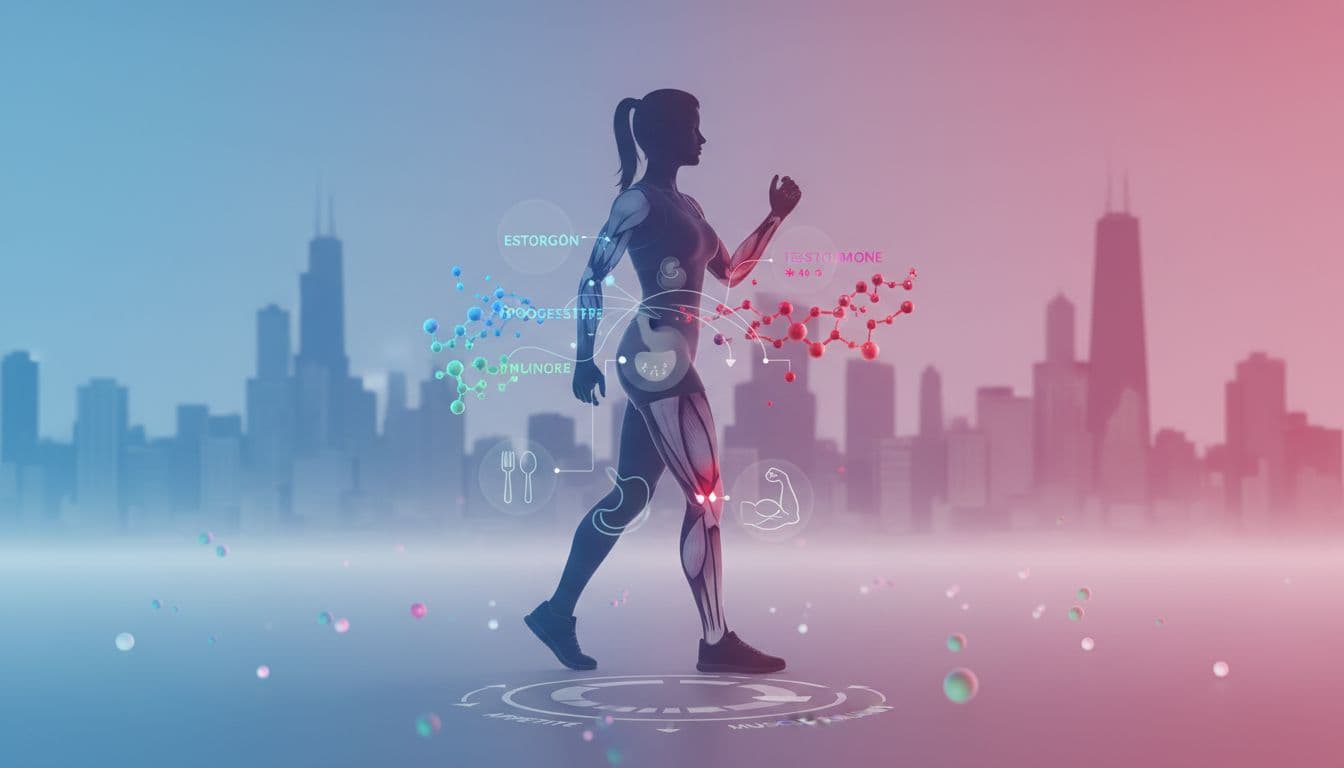
Think of hormones as your body’s “settings.” Food, training, sleep, and stress still matter most, but hormones can change how strongly your body reacts to those basics.
Here’s the plain-language version:
- Estrogen helps regulate fullness, cravings, and how your body distributes fat.
- Progesterone rises after ovulation, and often increases appetite and cravings. It can also change fluid balance (hello, bloating).
- Testosterone is present in women in smaller amounts, and supports lean mass, strength, and recovery.
In midlife, hormone shifts often show up as a new waistline, stubborn belly fat, and muscle that seems to “slip away” faster. Less muscle can lower your daily calorie burn, which makes weight loss feel unfair even when your habits are steady. If you’re also sleeping poorly (night sweats, stress, a baby waking up), the effect gets louder.
If you want a deeper look at what’s normal and what isn’t during the transition, this guide can help: https://wohcc.com/perimenopause-vs-menopause-guide/
Appetite, fat storage, and muscle, what changes first when hormones shift
Early changes are often subtle, but they’re real:
You may notice stronger cravings, especially for salty or sweet foods. You might also feel less satisfied after meals, like your “off switch” is slower.
Body shape can shift before the scale does. Belly fat can creep in, even if your weight stays close to the same. Muscle gains may feel slower, and soreness can linger longer than it used to.
Sleep, stress, and low daily movement can magnify all of this. A few rough weeks of sleep can push cravings and recovery in the wrong direction, even if your meals look fine on paper.
Body composition vs. the scale, why you can look different at the same weight
Your scale only tells you total weight. It doesn’t tell you how much is fat mass versus lean mass (muscle, bone, water).
If you lose a bit of muscle and gain a bit of fat, you can weigh the same but look softer. Clothes fit differently. Your waist changes. Your strength drops. That’s why many women feel stuck during weight loss even when they’re “doing everything right.”
A better scoreboard is often: waist size, how your clothes fit, your strength numbers, your energy, and your hunger levels across the week.
Estrogen, how it affects fullness signals, belly fat, and muscle recovery
Estrogen does more than control your cycle. It’s tied to mood, sleep quality, temperature control, and body fat patterns.
When estrogen is steadier and higher (often earlier in the cycle), many women find appetite easier to manage. When estrogen drops, hunger can rise, and cravings can feel more urgent.
Estrogen also relates to fat distribution. Higher estrogen tends to favor more storage around hips and thighs. Lower estrogen is linked with more central storage, meaning more fat around the waist.
It also supports training response and muscle recovery, though it’s not the main muscle-building hormone. When estrogen is low and sleep is poor, workouts can feel harder to bounce back from.
When estrogen drops, why appetite can rise and cravings can feel louder
Estrogen drops happen in a few common windows:
- Late luteal phase (right before your period): your appetite can climb and portions can creep up without you noticing.
- Postpartum: hormone levels drop sharply after delivery, and sleep disruption can push hunger and comfort-eating hard.
- Perimenopause and menopause: estrogen becomes more unpredictable, then stays consistently low after menopause.
The most useful move here is pattern awareness, not restriction. If you know your “snackier” week is coming, you can plan for it. That might look like more protein at breakfast, a real afternoon snack (not a vending machine gamble), and earlier bedtime when you can.
If hormone changes are also hitting your mood or anxiety, this can be worth reading: https://wohcc.com/hormones-and-mental-health-women/
Estrogen and belly fat in midlife, why fat can shift to your waist
Belly fat isn’t all the same. Some sits under the skin. Some sits deeper in the abdomen around organs. That deeper fat is often called visceral fat.
After menopause, lower estradiol is linked with increases in total body fat and more central fat. This can happen even with only small changes on the scale, which is why it can feel like your body “rearranged itself” overnight.
Hormone therapy (for the right person, with the right plan) may help limit central fat gain and support body composition. It’s not a weight-loss drug, and it won’t replace training and nutrition, but it can change the playing field by improving symptoms like sleep disruption and hot flashes.
For a practical discussion of what to expect, start here: https://wohcc.com/hrt-weight-changes/
Progesterone, why the second half of your cycle can feel like snack time
Progesterone rises after ovulation, which is the second half of your cycle (the luteal phase). For many women, that rise comes with a bigger appetite and stronger cravings, especially as estrogen trends lower right before your period.
Progesterone can also shift fluid balance. Bloating, breast tenderness, and a “puffy” feeling are common. That’s often water, not fat gain, even if the scale jumps for a few days.
There’s another twist that surprises people: controlled research in postmenopausal women has found progesterone treatment increased muscle protein building (muscle protein synthesis). That doesn’t mean progesterone is a muscle shortcut, but it hints that progesterone may play a supportive role for muscle maintenance in some settings.
Progesterone and cravings, what’s normal vs. what feels extreme
Some extra hunger in the luteal phase is common. You might feel best with a bit more food, especially protein and high-fiber carbs.
It may be time to talk with a clinician if you notice cravings that feel unmanageable, along with any of these:
- major mood shifts that disrupt your day
- sleep falling apart for a week each month
- rapid body changes that don’t match your habits
- intense fatigue that makes workouts feel impossible
If you can, track patterns for 2 to 3 cycles. A simple notes app works. When you bring that pattern to an appointment, your symptoms stop feeling “random,” and your plan gets sharper.
Progesterone and muscle, a surprising link in newer research
In controlled research in postmenopausal women, progesterone treatment increased muscle protein synthesis by about 50%. That’s a lab measure of how fast your body builds muscle proteins.
What it might mean for you: progesterone may support muscle maintenance in the right context.
What it doesn’t mean: you can skip lifting, skip protein, and still build muscle. Training still gives your body the reason to build, and protein supplies the building blocks.
Testosterone in women, how it supports lean mass, strength, and body shape
Women make testosterone in smaller amounts than men, but it still matters. Testosterone supports lean mass, strength, bone, and often energy and drive.
When testosterone is balanced, it can be easier to train hard, recover, and maintain muscle. When it’s low, weight loss can get harder indirectly, because it’s harder to move more and push in workouts.
Too much testosterone can cause unwanted side effects. Dosing for women is small, and it needs medical supervision. It’s also not for everyone.
If you’re curious about local hormone therapy options, you can review: https://wohcc.com/hrt-biote/
Low testosterone signs that can affect weight loss effort indirectly
Testosterone isn’t usually a direct “hunger hormone,” but low levels can still mess with your results by changing how you feel day to day.
Common signs include low energy, low drive to work out, lower strength, slower recovery, and low mood. When you’re drained, you tend to move less and sit more, and your appetite choices get harder at 4 pm.
Even your NEAT (non-exercise activity like errands, stairs, cleaning) can drop without you noticing. That can be the difference between maintenance and slow gain.
Testosterone and muscle building, why lifting feels different when levels are low
Testosterone supports muscle protein building. In controlled research in postmenopausal women, testosterone treatment increased muscle protein synthesis by about 50%. That’s one reason it’s linked with strength and lean mass.
But more is not better. If levels get too high, side effects can include acne, unwanted facial or body hair, scalp hair loss, and voice changes. Some changes can be hard to reverse, which is why self-medicating is a bad idea.
A good goal is function: lifting groceries, feeling steady on stairs, keeping your back strong, and liking how your body feels in your clothes.
How hormone changes show up across your life (and what to do next)
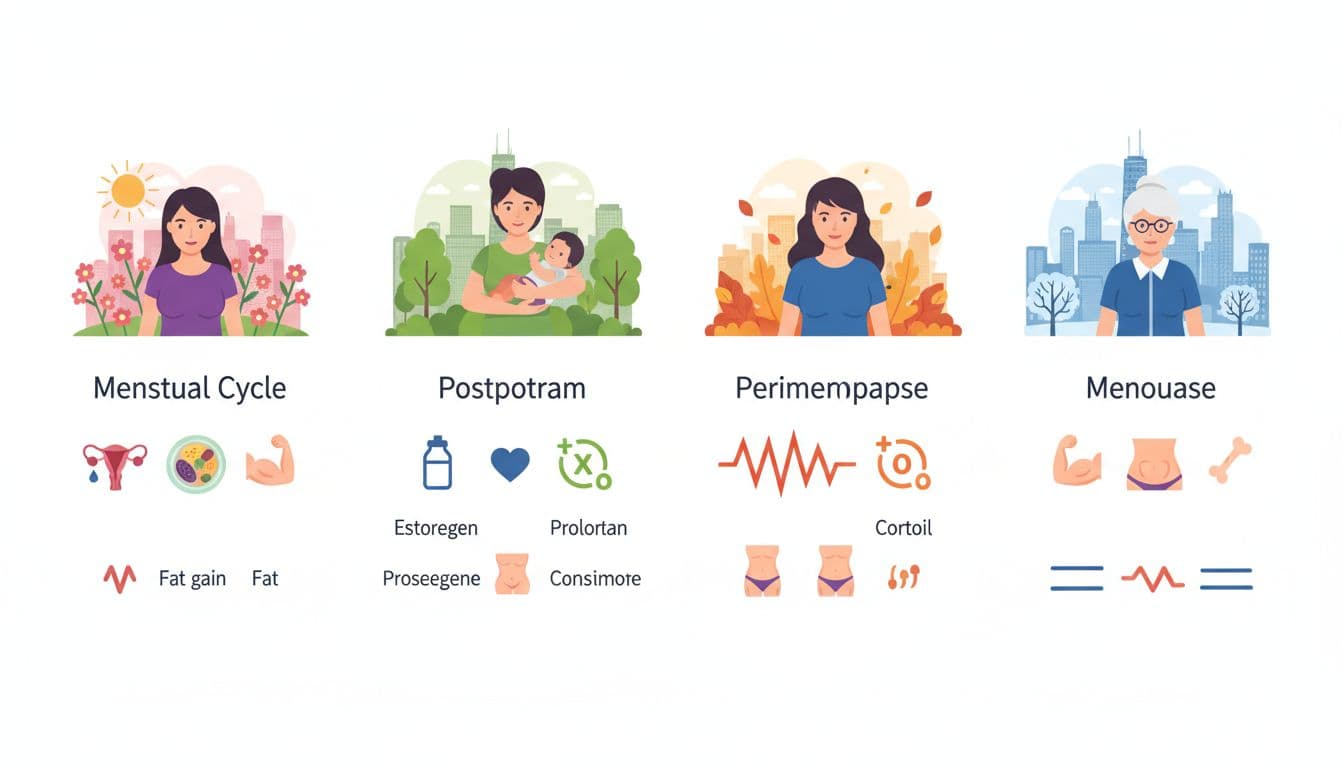
Hormones don’t change once. They change in chapters. If you can name the chapter you’re in, you can stop guessing and start planning.
Cycle, postpartum, perimenopause, menopause, what hormone patterns can explain
Here’s a quick cheat sheet you can come back to:
Life stage or phaseWhat you may noticeWhy it matters for body compositionFollicular phase (after period)appetite feels calmer, workouts feel smootherestrogen is often steadier, recovery can feel easierLuteal phase (after ovulation)more hunger, cravings, bloatingprogesterone rises, water retention can increasePregnancyeasier fat storage, changing appetiteyour body is built to store energy for growthPostpartumstrong hunger, poor sleep, mood shiftshormone drop plus sleep loss can drive appetitePerimenopause to menopausebelly fat shift, muscle loss, cravings, poor sleepestrogen becomes erratic, then stays low
If you’re unsure whether symptoms fit perimenopause or menopause, use this guide as a starting point: https://wohcc.com/perimenopause-vs-menopause-guide/
A realistic plan for weight loss when hormones are shifting
If hormones are raising the difficulty level, you need a plan that protects muscle and lowers decision fatigue.
A simple checklist that works in any stage:
- Strength train 2 to 4 times per week, even if sessions are short.
- Walk daily, especially on busy days when workouts don’t happen.
- Protein at each meal, so you stay full and support lean mass.
- Fiber and fluids, so cravings don’t run the show.
- Steady meal timing, which helps appetite feel less chaotic.
- Limit ultra-processed snacks in the luteal phase, or pre-portion them so you’re not eating from the bag.
- Protect sleep like it’s part of your program, because it is.
If symptoms are strong, if fatigue is ongoing, or if belly gain feels sudden, it’s time to talk with a clinician about testing and treatment options. A structured visit can also help you rule out common issues like thyroid problems, anemia, or insulin resistance.
If you want support that looks at the whole picture, consider: https://wohcc.com/menopause-management/ and keep up with routine care here: https://wohcc.com/routine-check-ups/
Conclusion
Estrogen often affects fullness and where fat sits, progesterone can raise appetite (and may support muscle-building signals in some research), and testosterone supports strength and lean mass. When these hormones shift, they can change how weight loss feels, even when your effort stays the same.
Your job isn’t to punish yourself for having a body. Your job is to notice patterns, protect muscle, and get support when symptoms are loud. If you’re dealing with strong cycle symptoms, rapid belly fat gain, or ongoing fatigue, schedule a visit with an OB-GYN or HRT specialist in Chicago to talk through your symptoms, risks, and a plan that supports Weight Loss and strength safely.
